In Q3 2025, 35.6% of direct repair program estimates included at least one calibration — up from 26.9% a year earlier, but still well short of the vehicles that actually need one. Your collision repair can be shaped long before you ever meet the estimator. That is the real starting point behind Insurance-referred shops vs. independent experts: the claim reality, and it is why the “claim reality” in 2026 is less about paperwork and more about correct collision repair decisions.
Key Takeaways
What changes in the claim process
|
What you should look for
|
- Q: What does “direct repair program” really mean for your car?
A: It usually means the insurer nudges you toward a specific auto body shop network, which can affect estimate structure and repair sequencing. - Q: Is an insurance-referred shop automatically lower quality?
A: Not automatically, but the program workflow can create blind spots if structural, ADAS, or aluminum details are under-scoped. - Q: What helps most in 2026?
A: A repair plan tied to manufacturer specifications, with documented measurements and calibration when needed.
Insurance-referred shops vs. independent experts: what “claim reality” looks like in 2026
When people compare Insurance-referred shops vs. independent experts: the claim reality, they often focus on who “wins” the paperwork. The more important reality in 2026 is what the process rewards, what it overlooks, and how quickly the repair plan can get the car back to a true pre-loss, pre-accident condition.
Insurance referrals typically start with the insurer steering you toward a shop that is already aligned with their process. An independent expert, by contrast, tends to build the repair plan from the vehicle outward, starting with structural integrity, fitment, and the required procedures for the specific make and model.
In collision repair, the vehicle is not generic. Modern vehicles blend high-strength steel, aluminum, and integrated systems that require correct repair sequencing. If the plan is shaped only by an estimate format, you can miss parts of the job that should be treated as mandatory safety and function steps.
When insurer referrals work, and when they don’t (based on what repair planning actually needs)
Let’s be practical. A well-run insurance-referred auto body shop can be fast, organized, and clear about timelines. In 2026, the best outcomes happen when the insurer’s workflow aligns with manufacturer specifications and the shop’s internal quality controls.
But here is where Insurance-referred shops vs. independent experts: the claim reality gets real. Collision repair is not just cosmetic work, it is structural restoration plus system validation. If the insurer’s workflow limits what gets inspected, documented, or scheduled, the repair plan can start too narrow.
- Structural damage: Frame and structural damage affects how the vehicle handles and how safe it is to drive.
- ADAS calibration requirements: Many modern repairs require calibration when sensors or mounting points are affected.
- Material-specific repair: Aluminum and steel cannot be treated as the same work type, and contamination control matters.
- EV and hybrid complexity: High-voltage-safe procedures are not optional in electric collision repair.
If you are unsure which path fits your vehicle, start by asking for the repair procedures tied to your specific make and model. That is what separates an estimate that “adds up” from a repair that restores.
Independent experts and calibration: why the “invisible work” decides the safety outcome
Calibration work often feels invisible because it is not always discussed in the same way as dent repair or paint matching. But in 2026, ADAS systems are tied to how the car brakes, steers, and stays aligned with its driving lane logic.
That is why Insurance-referred shops vs. independent experts: the claim reality includes a key question: “Who checks what will be affected after the body work?” Independent experts typically evaluate the vehicle’s systems and then confirm whether calibration is needed after frame correction, component replacement, or sensor-related repairs.
Even when an insurer points you to an auto body shop, you still want clarity on calibration steps and the documentation trail. A quality collision repair plan should spell out what is scanned, what is calibrated, and why it is required for safe operation.
At our shop, we understand that the repair is not done when the dent looks better. The goal is function restoration. If systems are affected, we treat calibration as part of the repair, not an optional add-on.
Frame straightening and aluminum repair: where independent process matters most
One of the biggest gaps people run into is material handling. In many collisions, the structural work includes mixed materials, and the procedure must match each material. Aluminum repair requires dedicated equipment kept separate from steel work. That is not a preference, it is a contamination control requirement.
When you hear “independent expert” versus “insurance-referred shop,” think about how each approach handles documentation and tolerances. Frame straightening and structural repair should compare your vehicle to manufacturer specifications using proper measuring tools. That is where independent planning often shines, because the focus is structural integrity first, not just estimate totals.
Modern repair also depends on measurement discipline. Laser dimensioning systems and OEM repair procedures help us restore components to their original position by comparing dimensions against specs and documenting where required.
If you want a real example of our approach, see our structural repair overview at frame straightening and structural repair. It covers the equipment and OEM repair procedures we use when safety depends on exact fit and alignment.
EV and hybrid collision repair: insurer referrals can complicate the workflow
In 2026, more vehicles in everyday fleets are electric or hybrid, and collision repair has to match that reality. EV and hybrid repair is not the same work as conventional dent repair, because high-voltage-safe procedures and battery-aware repair steps are required.
This is where Insurance-referred shops vs. independent experts: the claim reality often becomes a timing and documentation issue. If the referral workflow does not account for high-voltage safety, you risk delays, incomplete planning, or missing steps that should be handled before the vehicle is reassembled.
We keep this part straightforward. When EV or hybrid vehicles are involved, our technicians follow high-voltage-safe, applicable OEM repair procedures and back qualifying work with a lifetime workmanship warranty. We also handle ADAS scanning and calibration when required through trusted partners.
If your claim touches these vehicle types, review our EV repair capability at EV collision and auto body repair and our hybrid repair approach at hybrid vehicle collision repair.
Axalta refinish, downdraft booths, and why “blend” is more than aesthetics
People notice paint first, which is why auto painting often becomes the headline in the conversation. But Insurance-referred shops vs. independent experts: the claim reality includes refinish quality because paint is not just appearance, it is durability and correct finish blending.
Modern collision repair demands controlled environments and precise color matching. We use Axalta refinish products with computerized color mixing so the repaired area blends closely with surrounding panels. Downdraft paint booths help control contamination so the finish comes out consistent and accurate.
That process also affects how dent repair transitions into the refinishing stage. If structural work shifts, or panel alignment is off by the wrong tolerances, you will see it in the seam and in the way reflections land across the repaired area.
To see the details behind our process, go to auto painting and refinishing.
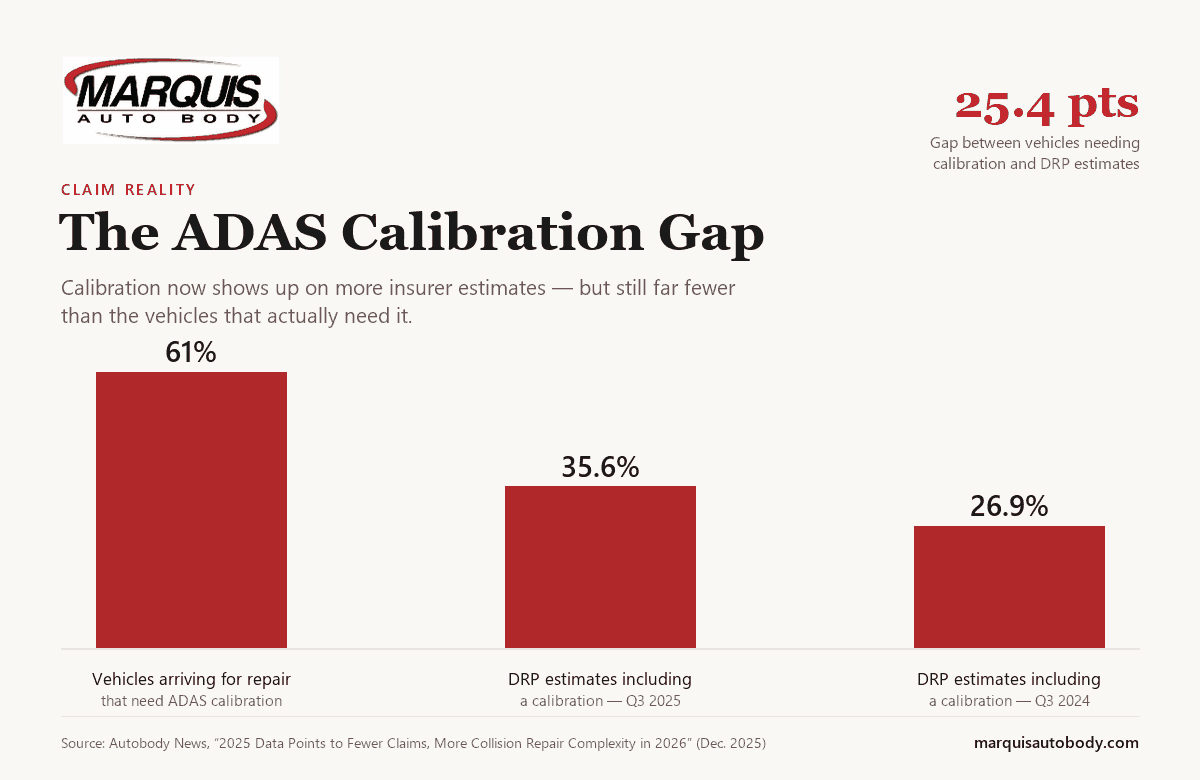
Calibration is reaching more insurer estimates, but a wide gap remains between what vehicles need and what estimates capture.
How to protect your outcome: questions that cut through referral pressure
No matter where your claim starts, you can protect the end result with the right questions. Think of this as your checklist for collision repair decisions in 2026, especially if your claim involves dent repair, paint blending, or structural restoration.
When you talk to an auto body shop, ask:
- Will you follow manufacturer specifications for this vehicle? If the shop says “generic approximations,” that is a red flag.
- How do you handle structural measurements? Ask about laser dimensioning systems or other electronic measuring tools tied to specs.
- Is aluminum repaired with dedicated tooling and contamination control? This matters for long-term structural integrity.
- Do you confirm whether ADAS calibration is required after the repair? Do they scan and document when systems are affected?
- How do you handle EV or hybrid collision repair safety steps? Ask about high-voltage-safe procedures and OEM protocols.
- What is your written estimate process? A free written estimate is a baseline, then the repair plan should be clear.
Also, pay attention to communication. Professional office staff and procedures matter because you need an advocate when you deal with insurance claims. Whether you file an insurance claim or pay out of pocket, we work with you to ensure your needs and expectations are met.
If you want to understand how we handle claims directly, start with collision repair in Santa Rosa and then explore how we support customers through the process with our approach and history.
Marquis Auto Body as an advocate: what we do differently for claims
We know accidents can be stressful, but when you choose our auto body shop to perform your collision repair, you have chosen a repairer that is quality driven. That matters because quality is not a slogan, it is a system you can feel in how the vehicle is measured, repaired, and verified.
We handle collision repair with I-CAR Gold Class recognized training standards, and we focus on OEM/Manufacturer specifications for every vehicle, not generic approximations. Our team uses dimensioning systems and follows procedures designed for the tolerances your vehicle was built to.
We also support customers through insurance complexities with professional office staff and procedures to be sure we are your advocate when dealing with insurance claims. Whether you are filing an insurance claim or paying out of pocket, we work with you to ensure your needs and expectations are met.
If you want to see how we position our repair capabilities and quality controls, visit the Marquis difference. And if your claim involves estimates and next steps, we also offer an online photo estimate so you can skip the first trip and get a start quickly.
Quality Driven for Over 40 Years. Marquis Auto Body consistently delivers trusted, on-time services with your best interest in mind. You can be rest assured that when you choose Marquis Auto Body we will handle all the details and get you back to your busy life.
Conclusion
Insurance-referred shops vs. independent experts: the claim reality in 2026 is simple, the repair plan must match the vehicle, the damage, and the required safety steps. Referrals can move the process along, but independent process thinking, documented measurements, ADAS calibration checks, and material-specific collision repair decisions determine whether the outcome truly returns to pre-loss, pre-accident condition.
If you want a collision repair experience built on tolerances, specialized tooling, and accountability, choose an auto body shop that treats dent repair, aluminum work, and EV safety as the technical work it actually is.
Frequently Asked Questions
Are insurance-referred shops usually better than independent experts in 2026?
Not necessarily. In 2026, Insurance-referred shops vs. independent experts: the claim reality depends on whether the shop follows manufacturer specifications, documents structural work correctly, and confirms ADAS calibrations when required.
What should I ask an auto body shop if my insurance is steering me to their network?
Ask how they build the repair plan for your exact make and model, how they measure for structural integrity, and whether aluminum repairs involve dedicated tooling and contamination control. For dent repair and collision repair, you should also ask when ADAS scanning and calibration are required.
Will choosing an independent expert help prevent missed ADAS calibration?
It can, because independent experts often evaluate system impacts rather than relying only on estimate format assumptions. Since a large share of vehicles need calibration after collision repair, this is a major part of Insurance-referred shops vs. independent experts: the claim reality in 2026.
Is aluminum repair different from steel repair for collision repair?
Yes. Aluminum repair involves material-specific procedures and specialized tooling, and improperly repaired aluminum is invisible to the eye but compromises the vehicle’s structural integrity and can cause long-term corrosion issues. This is a key difference in high-quality dent repair and collision repair planning.
Can an insurance-referred shop handle EV collision repair safely?
They can if they follow high-voltage-safe, applicable OEM procedures and treat battery safety as part of the workflow. In Insurance-referred shops vs. independent experts: the claim reality, the question is whether the shop is genuinely prepared for EV and hybrid repair requirements.
What evidence should I expect during the claim process to know the repair will be correct?
Look for documentation tied to manufacturer specifications, measurement methods like laser dimensioning systems when needed, and a clear plan for calibration steps if ADAS systems are affected. A shop that provides a free written estimate and communicates the repair plan clearly is usually easier to trust during collision repair.